
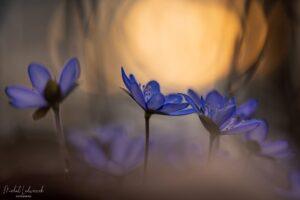
29 April 2026Here I am with a little update on this year’s spring. It is now in full bloom, the trees are already covered with fresh, intensely green foliage. I have already visited my favorite spots several times this year. Flowers were, as usual, my biggest point of interest. The hepaticas are the first signs of the season in my region. I love the contrast between their purple petals and last year’s dead brown flowers. However soon after white anemones start coming out of the ground and they are not messing around. Large areas of the forest are covered with them. Sometimes it is hard to find a spot without them. But not only the vegetation is interesting in spring. I had a chance to meet frogs and toads as they start their yearly activity with their mating season. Spring is definitely my favorite time of the year! [...]Read more...
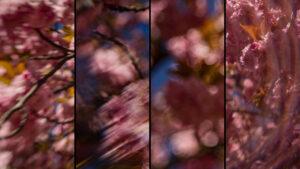
27 April 2026In today’s post, I’d like to show you how different effects can be achieved using several photographic tools for the same subject. The choice of equipment is highly subjective and dictated by my current preferences. So what are these secrets of creativity? They can be exposure techniques or the use of various additional elements attached to or held in front of the lens. It can also involve the use of specific lenses (known from their characteristic design) or specially modified lenses. Regardless, the point is that not only the main subject of the photo is important, but also its surroundings, and how out-of-focus areas are reproduced. Flowers are an ideal subject for this type of experimentation, as they don’t escape the camera. This gives us ample time to experiment with different techniques and gadgets. So, let’s get down to specifics.
Reference photos
My current basic setup for this type of photography is a body (it doesn’t really matter which one; any one will work equally well) with a Sony FE 70-200/4 Macro lens. It’s my current favorite lens due to its versatility, light weight, and relatively compact size. Here are the photos using just this “bare” setup.
Basic setup + HALO Spiral filter
First up is a filter with a very interesting design. It looks like a glass cone with a flattened center (see photo). With this design, you might expect to achieve sharpness only in the center of the frame, with all sorts of interesting things happening all around. And that’s exactly what happens. The outer part of the frame is full of turbulence. It depends on what you’re photographing and how it’s positioned in the frame. The filter’s names may vary from manufacturer to manufacturer, but pay attention to its construction.
It’s important to remember that relative sharpness can only be achieved in the center of the frame. Therefore, you’ll either have central crops or you’ll need to plan ahead how you want to crop the image.
Basic setup + Supernova II filter
As the second approach to creativity I’d like to propose uses the Supernova II filter. This is what mine is called, but I know that various manufacturers offer similar solutions. Again, the starting point for this filter is a fairly thick piece of glass. This time, however, we’re dealing with a different type of bevel. A strip of glass of equal thickness runs through the center of the filter, and on both sides the glass is beveled towards the edges. Furthermore, the filter is rotatable (similar to polarizing filters). As you can see, the effect we can achieve is a kind of motion blur off-center in the frame. By freely rotating the filter, we can adjust this “motion” in any direction. There’s also a version of the filter with a bevel on only one side. In that case the effect occurs only on one side of the frame.
TTArtisan 100mm/2.8 Bubble Bokeh lens
Let’s move on to something that was a huge hit not so long ago. Achieving characteristic circles in bokeh (out-of-focus areas) was very appreciated. Few years ago, almost every photographer wanted to be able to achieve sharp-edged circles in out-of-focus areas. The topic was so hyped that the prices of legendary triplet lenses skyrocketed. Chinese lens manufacturer TTartisan decided to capitalize on the market and created a lens with a design identical to the legendary Meyer-Optik Trioplan 100mm/2.8. Also fascinated by bubble bokeh, I acquired this lens. Photos taken with it look like the ones below. Furthermore, the image is quite soft. The circles aren’t as pronounced, as the flowers in the background lack contrast. The best results can be expected when photographing bright reflections in water.
Lensbaby Composer
Finally, I left something I’d like to revisit after a while. The Lensbaby Composer, first found its way into my camera bag about eight years ago. Why did I decide to return to it after all these years? I’m not entirely sure, but maybe I feel like I haven’t explored all its capabilities?
What is a Composer? It’s a lens with a distinctive floating design, where the front element can be tilted in any direction. This allows you to focus only on a specific area of the frame. The further from the in-focus area, the more the image is stretched. A minor drawback is that the aperture is adjusted by manually changing plastic discs located inside the lens. The higher the f-number, the greater the area of focus relative to the out-of-focus area. However, I used an f/8 aperture disc for this session, and I think that’s the optimal setting. The results look like this:
Summary
As you can see above, photos of the same subject can look different thanks to the use of different tools. The main subject looks the same, but we have a huge influence on how we present its background and surroundings. Depending on what we like best, we can use various interesting tools. And what I’ve mentioned above is just the tip of the iceberg, because the possibilities are endless. Photography is a creative field, so it’s worth trying different tools and finding your own path. [...]Read more...
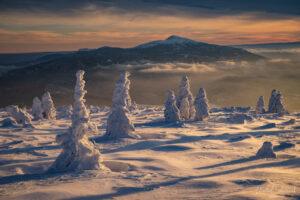
25 February 2026And so it happened, another winter Mt Pilsko event is history. This is my seventh time. This year’s edition was more challenging than usual for me. Health problems with our irreplaceable organizer Zygmunt forced me to take on the task of organizing this year’s event. In many ways, it wasn’t easy, as Zygmunt set the bar very high. Fortunately, participating in previous editions provided logistical knowledge, and the kindness of the participants gave me encouragement. Everything went smoothly. But that’s not all!
The icing on the cake was the weather at the top of Mt Pilsko. I don’t think we’ve experienced such conditions at any of our events before. Friday’s sunrise, with its incredible clouds illuminated by the sun, an inversion, strong winds, and trees covered in rime, is unforgettable. Climbing to the top of Mt Pilsko, I knew it would be alright. But at the very top, it turned out I’d entered a magical land. It was incredible, but also difficult. A few people even suffered mild frostbite. But I think it was worth it. Saturday brought a change in the weather, the wind shifted, and clouds enveloped the entire mountain. But that, too, had its charm. That’s how mountains are. [...]Read more...

